


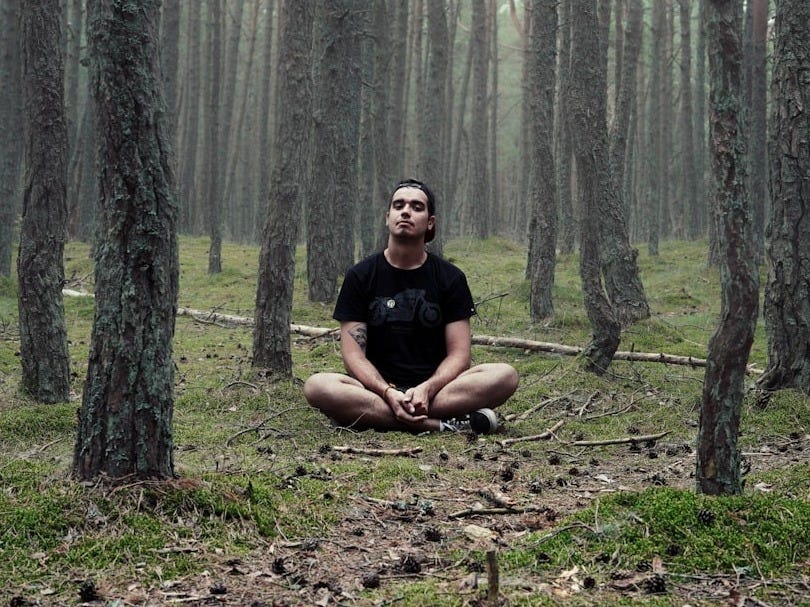
I started meditating again early this morning.
It had been a few months since I last sat down long enough to slow my breathing, unclench my attention, and watch my thoughts without immediately chasing after them.
Like riding a bicycle, the practice returned quickly. Not perfectly, but familiarly.
When I finished, I felt calmer. More centered. Less crowded inside my own head.
This has been a pattern for me for more than two decades. I find meditation. I lose it. Rinse and repeat, I return to it, again and again.
I was first introduced to meditation in 2001, when I took a course at a local Buddhist temple. The nun who taught it had once lived a life that, on paper, looked enviable.
Before becoming a nun, she had been an advertising executive, navigating deadlines, expectations, and the constant chaos of a world where everything feels urgent and nothing ever feels finished. Eventually, she stepped away from it all. Not out of failure, but out of clarity. She had grown tired of the noise. She wanted something quieter. Something truer.
So she devoted her life to peace. Not as an abstraction, but as a practice.
What stayed with me was not just what she said, but how she moved through the world. She spoke with focus, but without force. She listened without interrupting or quietly preparing her reply. She seemed to me, in a way that’s difficult to articulate, both amused and unburdened by most of what I consider “modern life.”
I am not religious. But I’ve always been fascinated by Buddhist psychology. Its focus is not on worship, but on observation. Not on changing the world, but on changing one’s relationship to it.
From my brief introduction to Buddhism, I learned that it begins with a simple but profound premise: Much of our suffering comes not from what happens to us, but from the stories we tell ourselves about what happens.
Meditation creates distance between the event and the story. It reminds us that our thoughts are interpretations, not facts. And from that awareness, we can see things more clearly, without adding extra weight that was never really there.
Meditation, at its core, is a way of interrupting those stories. Or at least noticing them.
For me, the goal has never been enlightenment or transcendence. It has been something quieter and more practical. A state of tabula rasa. A blank slate.
A state where my monkey mind is not reflexively narrating, judging, predicting, or defending. A state where I am not arguing with reality, rewriting it, or rehearsing conversations that will never happen. A state where I can see what is actually in front of me, instead of what I fear or hope might be there.
Most of the time, my mind behaves like an overactive attorney. It builds arguments and treats every detail as evidence. It fills in gaps with speculation and presents assumptions as fact.
Meditation doesn’t silence that voice forever. It just lowers the volume. And in that quieter state, something subtle but important shifts: The world stops feeling like something I have to manage and starts feeling like something I can simply witness.
This morning, sitting still and following my breath in and out, I was reminded of how much energy it takes to constantly be “on.” To maintain a narrative. To defend an identity. To carry yesterday into today without questioning whether it still belongs.
Meditation doesn’t demolish the mind. It clears it.
A blank slate is not the absence of self. It is the absence of interference.
Meditation is the difference between looking and seeing. Between reacting and responding. Between living inside my thoughts and living alongside them.
I know I will lose this practice again. I will get busy. Distracted. Restless. I will convince myself I don’t have time, which is usually when I need it most.
But the blank slate is patient. It waits beneath everything. Beneath the noise. Beneath the momentum. Beneath the version of myself I perform for the world, and the version I perform for myself.
It is always there, ready to be found again.
All it asks is that I sit down. Close my eyes. And begin.
Keep calm and just breathe!
Clint 🌈✌️
COLLIDE PRESS is a reader-supported publication.
Please consider becoming a Paid Subscriber or Patron.
FEBRUARY OFFER = 20% OFF SUBSCRIPTIONS
ends 02.28.26
ICYMI = IN CASE YOU MISSED IT
SUNDAY = Bodies For Everybodies
MONDAY = Buyer Beware
TUESDAY = Imposter Syndrome
WEDNESDAY = To Netflix + Chill (Or Not)
THURSDAY = 'No One Needs To Know'
FRIDAY = Rest In Peace, Kings + Queens
SATURDAY = Time, Time, Time...
BORN THIS WAY ON THIS DAY
02-22 = Billy Name (1940-2016) = American photographer and filmmaker 🌈
02-22 = Drew Barrymore (1975- ) = American actor and talk show host 🌈
02-22 = Edna St. Vincent Millay (1892-1950) = American poet and playwright 🌈
02-22 = Jane Bowles (1917-1973) = American writer and playwright 🌈
02-22 = Kimball Allen (1982- ) = American writer, playwright, and actor 🌈
MAN CRUSH(ES) OF THE DAY

“He was, as Billy Name said in the acclaimed Ric Burns documentary about Andy Warhol, uninterested in being a second-tier artist. He was uninterested in being a first-tier artist! He wanted to be, you know, a god. Someone who completely changed the...he wanted to be Zeus with the lightning bolt and nothing less would have satisfied him.”
Bob Colacello
Yep. There's a kind of baseline state that never quite goes away. It changes slowly, subtly, like the difference between the Mediterranean and the Caribbean, but otherwise it's still ocean. No goal, just being present. It unfolds a lot of mysteries, never on any schedule. I forget it, too. I've been forgetting it off and on since about 1975. It's good when you remember it.
Me, I need something to rouse me from my Tabula Rasa TBH, I need to be alive again, be aware, be vital. Trouble is I can't be arsed 😯 Still I can say Cheers DougT🏴 🇬🇧