


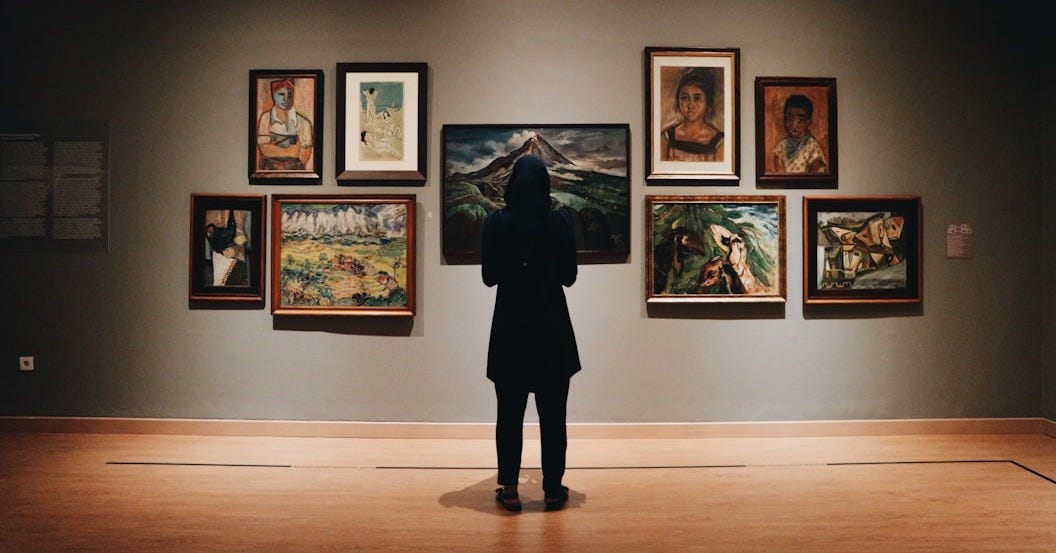
The art exhibit I went to this weekend was really inspiring.
The art talk afterward? Not so much.
The truth is, I don’t typically enjoy hearing artists talk about their work. That might sound strange coming from a fellow creative, but I said what I said.
You’d think the person who made the art would be the best person to explain it. Sometimes they are. But usually, language gets in the way of a good time.
There’s a certain kind of art world jargon that makes my skin crawl. Long sentences. Big concepts. Academic words that might sound impressive to some, but often feel disconnected from the work itself. Art talk can be so pompous and self-involved.
Meanwhile, the art sitting right there on the wall is playful, curious, and alive.
That contrast always fascinates me. The work feels immediate. You look at it, and something magical happens. Maybe you laugh. Maybe you pause. Maybe you don’t get it at all. But there’s a moment between you and the piece.

For me, that moment doesn’t really need explanation or translation. Yet during most art talks, the explanations become more complicated than the art itself.
I understand why it happens. Artists are often asked to place their work in a larger context. Curators want statements. Critics want ideas they can connect to bigger conversations. Blah, blah, blah…
I think it’s ironic that most successful art movements didn’t begin with complicated explanations. At most, maybe a short manifesto or a loose mission statement.
What gets most art movements started are artists making things. Trying something new. Breaking a few rules. Following an odd idea just to see where it might lead.
In other words, they walked the walk before anyone started talking the talk.
And I think that order matters.
When art works, the most interesting conversation isn’t the one happening at the artist panel after the show. It’s the quiet one happening between the art and the person standing in front of it.
Art is for everyone. The artists who make it. The critics who analyze it. The curators who present it. The collectors who support it. And the people who simply love looking at it.
All of those perspectives are part of the conversation.
But none of them owns the experience.
In the end, art lives in the connection between the work and the viewer. That moment of curiosity. Confusion. Delight. Recognition. Whatever it happens to be.
And the best part?
You don’t need a panel discussion to experience it.
Keep calm and art on!
Clint 🌈✌️
COLLIDE PRESS is a reader-supported publication.
Please consider becoming a Paid Subscriber or Patron.
FROM THE ARCHIVES
BORN THIS WAY ON THIS DAY
03-10 = Angela Morley (1924-2009) = English composer and conductor 🌈
03-10 = Jack Baker (1942- ) = American activist 🌈
03-10 = Janet Mock (1983- ) = American writer, TV host, and activist 🌈
03-10 = Jean Wyllys (1974- ) = Brazilian lecturer, journalist and politician 🌈
03-10 = John Rechy (1931- ) = Mexican-American novelist and essayist 🌈
03-10 = Peter Berlin (1942- ) = German photographer, model, and artist 🌈
MAN CRUSH OF THE DAY
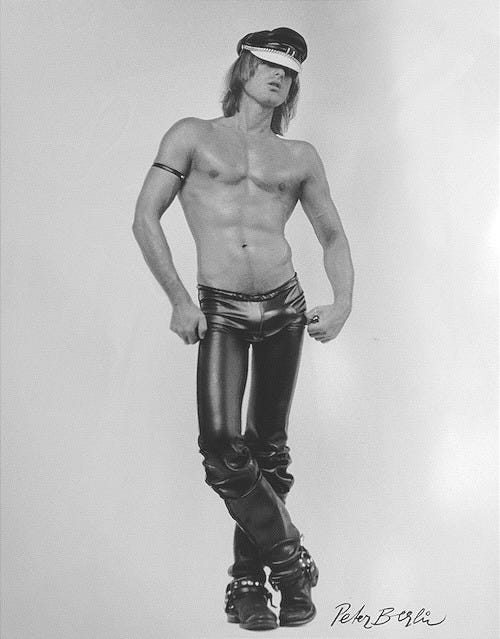
“Everyone has a secret fantasy life. I show you that it is possible, you know, to turn your sexual fantasy into reality, if you dare to.”
Peter Berlin
As a general reference for this phenomenon in art: "The Painted Word" by Thomas Wolfe. On the topic of the philosophy of aesthetics generally: "Zen and the Art of Motorcycle Maintenance." Or Aristotle. Whoever floats your boat. I never listen to artists about their art unless they are talking processes, or to writers about the meaning of their works. As you say, these interfere with perception and enjoyment. Even good old WB Yeats, who was called to do this stuff was not so interesting as his life was: poet, revolutionary, politician, playwright, frustrated lover. The wry ones are best at this. G.K. Chesterton, when asked to send a response to a newspaper about the question of "what's wrong with the world," wrote: "I am." Brilliant.
Right on, honey.
I agree with you and Clarke. A casual discussion with an artist is worth much more than the obfuscating verbiage to make things seem much more intellectual. And, yes. the real communication (if there is one) is between the art and observer.
Often it is a gut reaction not a cerebral one.