


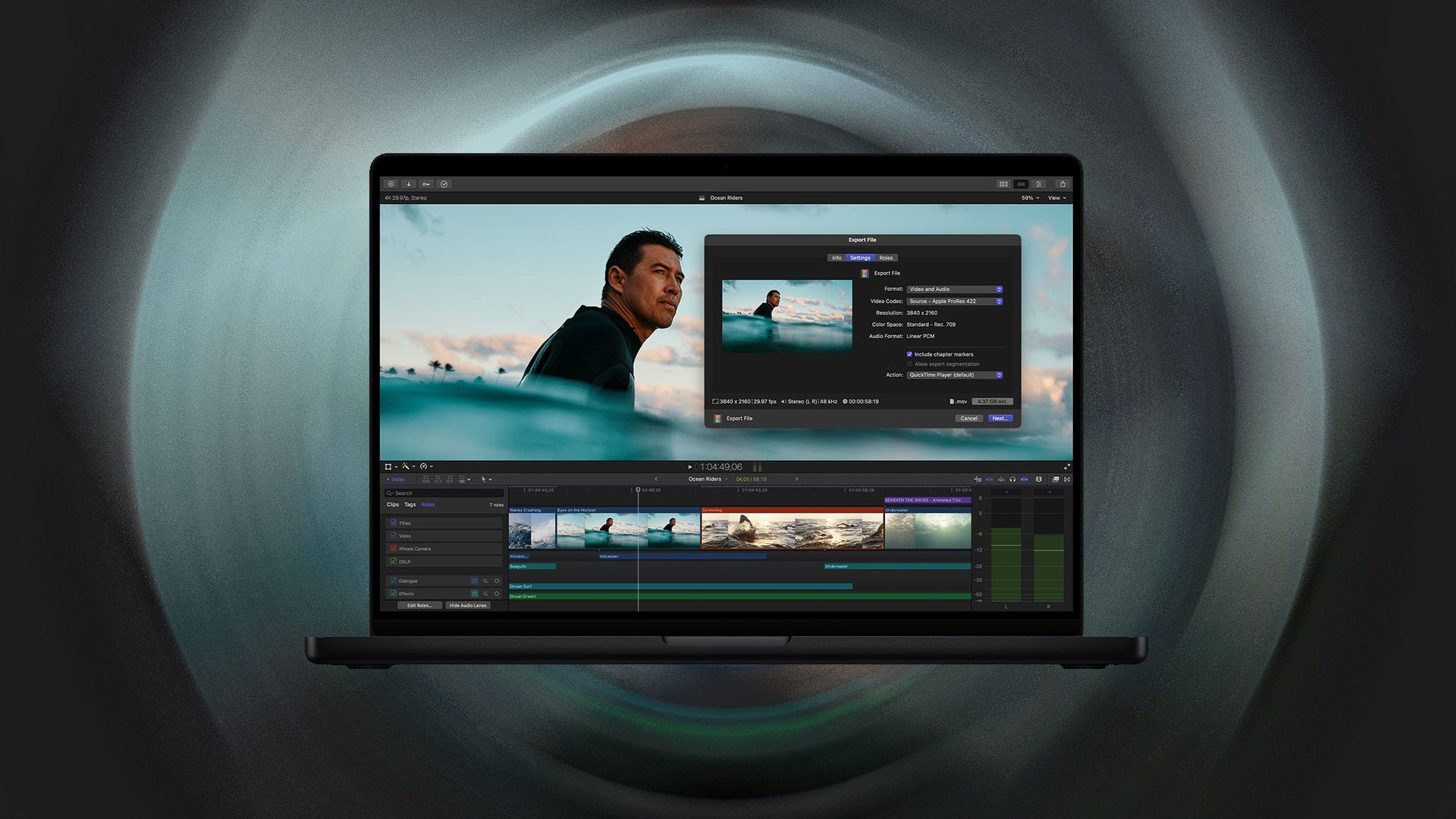
After a week of countless tutorials and lots of trial and error, I threw up my hands yesterday and admitted that Final Cut Pro is not the video editing software for me.
At least not right now.
This wasn’t a dramatic decision. It was quieter than that. More of a slow, creeping awareness. The kind where you think you’re making progress, feel just competent enough to be dangerous, and then hit a moment that makes you stop and wonder, “Why is this so fucking hard?”
Long story short: Once I (mostly) understood how Final Cut Pro worked, I realized it was missing some of the basic features that make me love CapCut. Features I have come to expect and rely on for my current editing style and workflow. Not advanced or niche tools. Just simple, everyday things that make editing easier and more fun.
And that’s when the real realization landed. Not “I failed to learn Final Cut Pro,” but “I might be using the wrong tool for what I’m actually trying to do.”
Then I had to admit something else: No one ever told me I had to use “professional” software. There was no external pressure. No client. No industry mandate.
The voice (of reason?) was coming from inside my own head. From my fragile ego. And, if I’m being honest, from my holding-on-for-dear-life insecurity.
Somewhere along the way, I internalized the idea that to be taken seriously, I had to use “serious” tools. That if I wasn’t using the same software as “real” editors, then what I was doing must be less valid. Less “real.” Less professional.
Final Cut Pro is undeniably powerful. It’s built for films, documentaries, and broadcast projects. But it’s also like relearning a foreign language I haven’t spoken since high school. Relearning languages takes time, energy, and patience. All of which I have in limited supply.
My goal right now isn’t mastery. It’s momentum.
This is where “professional” software reveals its hidden cost: Complexity and friction. User interfaces that make you feel like you’re constantly studying for a test instead of creating.
In theory, all that complexity exists to give you more control.
In practice, it often feels like you’re wrestling the tool instead of working with it.
CapCut, by contrast, lives firmly in prosumer land. It’s designed for people who want to make things quickly, intuitively, and without needing to rewire their brains first.
Is CapCut as powerful as Final Cut Pro? Absolutely not.
Can it do 95% of what I actually need to do? Absolutely.
At some point, raw power matters less than friction. Creative momentum is fragile. When small tasks turn into research projects, the cost isn’t just time. It’s energy.
With Final Cut Pro, I’m in learning mode.
With CapCut, I’m in making mode.
This isn’t the first time I’ve run into this problem. When I started doing graphic design, I didn’t know how to use Photoshop. It was the industry standard. The thing “real” designers used. And, naturally, imposter syndrome reared its ugh-ly head.
For the first five years of my career, I avoided Photoshop like the plague. I preferred Fireworks because it was faster, simpler, and more intuitive for the kind of work I was doing at the time: logos, layouts, and web graphics.
Photoshop felt heavy. Overkill. Like bringing a power drill to hang a picture.
It took years before Photoshop stopped feeling intimidating and started feeling useful. Not because Photoshop changed, but because I did. My projects changed. My needs changed. My mental model finally caught up to the tool.
That experience taught me something I keep relearning: tools are just tools until you put them to good use. How “professional” they are says less about the software and more about the person using the software.
A professional with the “wrong” tool can still make great work.
An amateur with the “best” tool can still feel completely stuck.
In my desire to be “professional,” I realized I’m more of a “prosumer” guy.
I like tools that are intuitive. Expressive. A little flashy. Tools that help me get from idea to output without making me go back to school to get another degree. I don’t need the most serious, industrial-grade setup to feel valid.
Maybe one day I’ll come back to Final Cut Pro. But right now, I just need tools that let me create without draining the joy out of creativity. I want tools that feel like collaborators, not obstacles. I want to spend my limited creative energy on ideas, not interfaces.
So, for me, Final Cut Pro doesn’t make the cut. Not because it’s bad. But because it’s not the right tool for me. For now.
Keep calm and edit on!
Clint 🌈✌️
COLLIDE PRESS is a reader-supported publication.
Please consider becoming a Paid Subscriber or Patron.
VALENTINE’S DAY OFFER
20% Off Subscriptions
FROM THE ARCHIVES
BORN THIS WAY ON THIS DAY
02-11 = Ellen Day Hale (1855-1940) = American artist 🌈
02-11 = Tammy Baldwin (1962- ) = American politician 🌈
MAN CRUSH(ES) OF THE DAY

“The world can criticize me, but l can always criticize it back.”
Bad Bunny

“When you take things too seriously, you get old. You have to be silly. Whenever people say, ‘Hey, man, are you ever going to grow up?’ That’s when you know you’re doing things right.”
Ricky Martin
Good enough. Good enough tech, good enough you. Relax, enjoy, create.
Clint, it's all trial and error until you realise what you really want/need, keep on keeping on, Cheers DougT 🏴🇬🇧